
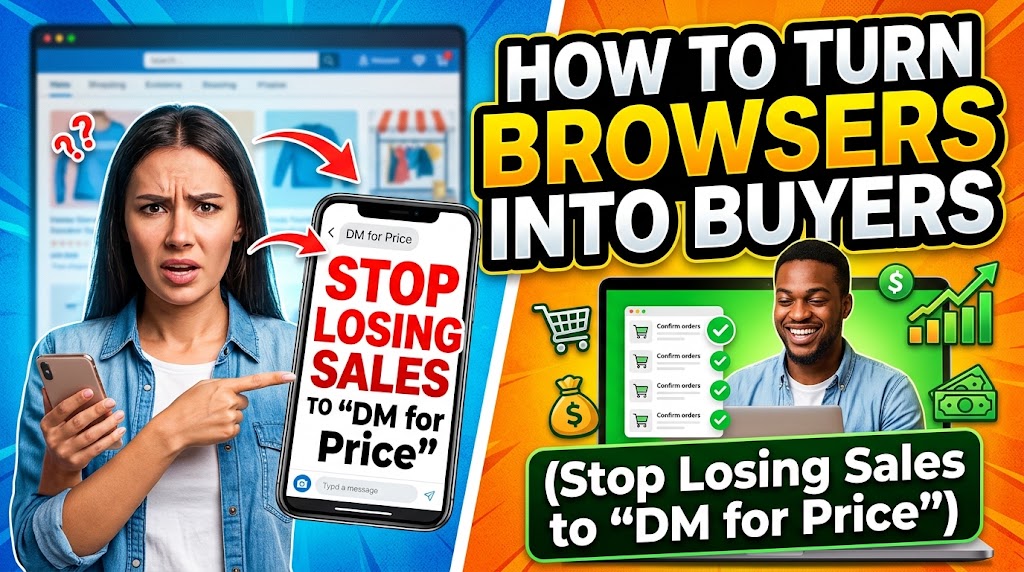
If you have ever posted a product online, received plenty of views, watched people ask questions, and still ended the day with almost no sales, you already know the frustration of having browsers instead of buyers. Your content may be getting attention. People may be visiting your page, checking your status, reading your captions and even asking, “How much?” Yet somehow, the money is not following the attention.
This is one of the biggest problems many businesses face online. They assume that getting people to see a product is the hardest part. In reality, visibility is only the beginning. Getting someone to stop scrolling is one thing. Getting that person to trust you, understand your offer, see its value and actually pay for it is something completely different.
Learning how to turn browsers into buyers is therefore not simply about posting more often. It is about understanding what happens between attention and payment. Every person who visits your website, social media page or product listing is entering a journey. Some are curious. Some are comparing prices. Some are ready to buy. Others are interested but need more information before making a decision.
Your job as a business owner is to make that journey easier.
One of the biggest obstacles to this is the famous phrase that has become almost a tradition in online Nigerian business: “DM for price.”
There are situations where private conversations make sense, especially when the price depends on specifications, quantity, location or negotiation. But for many businesses, hiding the price creates unnecessary friction. A potential customer sees your product, becomes interested and then discovers that they have to send a message simply to find out how much it costs.
That tiny inconvenience can be enough to lose the sale.
Imagine someone is scrolling through Instagram or Facebook late at night. They see a shoe they like. They click the page and see, “DM for price.” They think, “Let me check another vendor.” Five minutes later, they have forgotten your business completely.
You did not necessarily lose the customer because your product was too expensive. You lost the customer because you made the buying process harder than it needed to be.
If you want to understand how to turn browsers into buyers, start by looking at your business from the customer’s perspective rather than your own.
Business owners often think, “I have posted the product. The customer can message me if interested.”
The customer is thinking, “Why should I message this person? What exactly am I getting? How much is it? Can I trust this seller? How quickly can I receive it? What happens if there is a problem?”
The difference between those two perspectives is where many sales disappear.
A buyer needs clarity.
They need to know what you are selling, who it is for, what problem it solves, how much it costs, what makes it different and how they can get it. If your online presence forces them to investigate all these things themselves, you are creating unnecessary resistance.
Think about a physical shop. If a customer walks into a shop and sees a product without a price tag, they may ask the salesperson. But if every single item in the shop has no price, the experience becomes frustrating. Online businesses sometimes recreate this exact problem through social media posts.
A customer sees, “Premium office shoes available. DM for price.”
Another product says, “Beautiful wigs available. DM for price.”
Another says, “Website design available. Send a DM.”
Soon the customer is doing detective work just to understand what the business sells.
This is why one of the simplest ways to turn browsers into buyers is to make your offer obvious.
Do not make people guess.
If your price is straightforward, consider displaying it. If you offer different packages, show the starting price or clearly explain what determines the final price. If you cannot publish a fixed price because every project is customised, explain what the customer gets and provide a clear starting point.
For example, “Business website packages start from ₦150,000 and include domain, hosting, mobile optimisation and five essential pages” is much more useful than “DM for website price.”
The first statement helps the customer qualify themselves.
Someone whose budget is below ₦150,000 immediately knows they may need another option. Someone comfortable with the price can contact you with genuine buying intent.
That is valuable because you are not merely generating messages. You are generating better messages.
The second major principle is to sell the outcome, not merely the product.
People rarely buy products simply because the products exist. They buy what those products represent.
Someone does not necessarily buy a website because they love websites. They may want more credibility, more enquiries, easier customer communication or a professional online presence.
Someone does not buy a fitness programme simply because they want a PDF containing exercises. They want progress.
Someone does not buy a cake because they need flour, eggs and icing. They want to celebrate an occasion.
Someone does not buy business software because they enjoy software. They want to save time, reduce errors or organise their business.
Your marketing should therefore answer an important question: “What changes for the customer after they buy this?”
If your product description only talks about features, you may be forcing the customer to figure out the benefits themselves.
Instead of saying, “Our website package comes with five pages,” you could explain, “Get a professional five-page website that gives potential customers a clear place to learn about your business, view your services and contact you.”
The feature is still there, but the customer can now understand why it matters.
Another important part of learning how to turn browsers into buyers is building trust before asking for money.
Online customers are naturally cautious. They cannot physically inspect your office. They may never have met you. They may have seen businesses disappear after receiving payment. They may have been disappointed by poor products or services before.
So when someone visits your page, they are not only evaluating your product. They are evaluating you.
Your content should therefore demonstrate competence and credibility.
Show previous work.
Share testimonials.
Explain your process.
Answer common questions.
Show your business journey.
Demonstrate your knowledge.
Explain mistakes customers should avoid.
Show what happens after payment.
The more uncertainty you remove, the easier it becomes for someone to make a decision.
This is where educational content becomes powerful. A business that constantly says, “Buy from me” may eventually become background noise. A business that teaches customers how to make better decisions becomes more memorable.
For example, a website developer could publish content explaining why businesses lose customers through poorly designed websites. A property business could explain how buyers can verify land documents. A fashion business could teach customers how to choose the right fabric for different occasions.
You are selling, but you are also demonstrating expertise.
That combination can turn passive attention into active interest.
Your call to action also matters.
“Contact us for more information” is weak because it does not tell the customer what to do next.
A stronger call to action might be, “Send ‘WEBSITE’ on WhatsApp to get the package details.”
Now the customer knows exactly what action to take.
The same principle applies to your website. Do not make visitors search for the next step.
If someone wants to buy, give them a clear button.
If they want to ask a question, give them a clear contact option.
If they want to compare packages, show the packages.
If they want to book a consultation, provide a booking route.
Every unnecessary step creates an opportunity for the customer to leave.
Another mistake businesses make is assuming that every browser is ready to buy immediately.
They are not.
Some visitors are discovering you for the first time. Others are comparing alternatives. Some are interested but have no money today. Some are waiting for payday. Some need to convince a partner or business associate. Others simply need more information.
This means your marketing should not only target people who are ready to buy today.
You should build a system that moves people from awareness to interest, from interest to trust and from trust to purchase.
This is particularly important for businesses selling services or expensive products.
A person may not spend ₦300,000 with you after seeing one Facebook post. But they may see your post today, read another tomorrow, watch a demonstration next week, read a testimonial later and eventually contact you when they are ready.
Your content is therefore doing more than generating immediate sales. It is building buying confidence.
One of the most effective ways to increase conversions is to answer objections before the customer raises them.
Ask yourself what stops people from buying.
Is it price?
Trust?
Delivery?
Quality?
Timing?
Fear of making the wrong choice?
Lack of understanding?
If customers frequently ask, “Is delivery available?” put the information in your content.
If they ask, “How long does it take?” answer it.
If they ask, “Can I pay in instalments?” explain your policy.
If they ask, “What happens after I make payment?” show the process.
Every repeated question is potentially a missing piece of your sales content.
This is why customer questions are marketing gold.
Instead of getting annoyed because people keep asking the same thing, turn those questions into posts, FAQs, videos and website content.
Your customers are literally telling you what information they need before buying.
Listen.
Another major factor is presentation.
You could have an excellent product and still struggle to sell it if your presentation makes the product look ordinary.
Photography, graphics, product descriptions, website layout, typography, videos and even the language you use can influence perceived value.
People make quick judgments online.
If your page looks abandoned, inconsistent or confusing, customers may assume the business itself is unreliable.
You do not necessarily need the most expensive branding in the world. You need consistency and clarity.
Your business name should be easy to understand.
Your profile should explain what you do.
Your bio should tell people who you serve.
Your posts should demonstrate value.
Your contact information should be easy to find.
Your product images should be clear.
Your prices or pricing structure should be understandable.
Your buying process should be simple.
That is how you create an environment where buying feels natural.
You should also stop treating every visitor as though they are equally valuable.
Someone who spends three seconds looking at your post is different from someone who visits your website, reads three pages, checks your pricing and returns the following day.
This is why having a proper website can be particularly useful for businesses that depend heavily on online customers.
Social media is excellent for attracting attention, but your website can become the place where that attention is organised into a proper buying journey.
Instead of sending everyone into a crowded DM inbox, you can direct potential customers to a page that explains your offer, displays relevant information, answers questions, establishes credibility and gives them a clear next step.
Your website can effectively keep selling even when you are sleeping.
That is a very different model from depending entirely on personal responses to every enquiry.
Imagine receiving 30 enquiries about the same product.
If every person asks, “How much?”
Then, “What colours are available?”
Then, “Do you deliver?”
Then, “How long does delivery take?”
Then, “How do I pay?”
You are spending time repeatedly answering questions that could have been addressed before the customer contacted you.
A strong sales page can handle much of that communication.
The customer arrives already informed.
Your conversation then becomes less about basic information and more about completing the sale.
This is the real meaning behind learning how to turn browsers into buyers.
You are not trying to manipulate people into purchasing things they do not need.
You are reducing uncertainty for people who already have a potential need.
That distinction matters.
Good conversion strategy is not about shouting louder. It is about communicating better.
It is about making your value obvious.
It is about making your price understandable.
It is about making your business trustworthy.
It is about making the next step simple.
And above all, it is about respecting the customer’s time.
If you currently use “DM for price” on almost everything, do not assume you need to remove it completely. Instead, ask whether it is genuinely helping your sales process.
For a customised service, you might say, “Packages start from ₦X. Send ‘QUOTE’ for a personalised estimate.”
For a product with a fixed price, show the price.
For multiple variations, show the price range.
For wholesale purchases, explain that wholesale pricing is available through enquiry.
The goal is not necessarily to expose every commercial detail. The goal is to give customers enough information to make the next decision confidently.
You should also create urgency carefully.
Fake urgency can destroy trust. If everything is “LAST CHANCE!” every day, customers eventually stop believing you.
Real urgency is different.
You can explain genuine deadlines, limited stock, promotional periods, delivery schedules or booking availability.
For example, “Orders placed before Friday qualify for this week’s dispatch” is more credible than endlessly shouting “BUY NOW!!!”
Customers respond to reasons.
Give them one.
Finally, measure what is actually happening.
Many business owners celebrate views, likes and followers while ignoring the numbers that determine whether the business is making money.
Ask yourself how many people see your content.
How many visit your page?
How many click your website?
How many enquire?
How many receive your price?
How many make a purchase?
How many become repeat customers?
These numbers reveal where your sales process is leaking.
If 10,000 people see your content but only 10 visit your website, you have an attention problem.
If 1,000 people visit your website but nobody contacts you, you may have a trust, offer or conversion problem.
If 100 people enquire but only two buy, your pricing, communication, offer or follow-up may need attention.
Do not simply say, “People are not buying.”
Find the exact point where they stop moving.
That is where the real problem is.
The most important lesson is that browsers are not useless. They are potential customers who have not yet been given enough reason, information or confidence to buy.
Your job is not to force every browser to become a customer.
Your job is to make it extremely easy for the right customer to recognise your value and take action.
So the next time someone tells you, “Your product is getting views but nobody is buying,” do not immediately conclude that your product is bad.
Look at the buying journey.
Can people immediately understand what you sell?
Can they see the price or understand how pricing works?
Can they tell why your offer is valuable?
Can they trust you?
Can they see evidence that you can deliver?
Can they get answers without asking the same questions repeatedly?
Can they easily buy?
Can they clearly see what to do next?
If the answer to several of these questions is no, you may not have a traffic problem.
You may have a conversion problem.
And that is good news because conversion problems can be fixed.
Learning how to turn browsers into buyers is ultimately about removing friction between interest and action. Stop making customers work too hard to buy from you. Stop hiding useful information behind unnecessary DMs. Stop assuming that attention automatically becomes sales.
Give people clarity.
Give them evidence.
Give them value.
Give them confidence.
Give them a simple next step.
Because your next customer may already have seen your product.
They may already have visited your page.
They may already like what you are selling.
They may already be interested.
The question is not always, “How do I get more people to see my business?”
Sometimes the better question is, “What am I doing that makes the people already watching me hesitate to buy?”
Answer that question honestly, remove the friction and you may discover that you do not need more browsers.
You simply need to become better at turning the browsers you already have into buyers.
Recommended: Grow Your Business Online
- Facebook Ads Domination (for Business Owners) — learn to run profitable Facebook ads and get more customers ($21). Check it out
- Facebook Advertising In 60 Minutes — fast-track course to launch your first ads in an hour ($50). Check it out
- FAF Mastery System — Facebook ads plus sales funnels that turn clicks into customers ($15). Check it out
Disclosure: These are affiliate links. If you buy through them, I may earn a commission at no extra cost to you.


Leave a Reply