
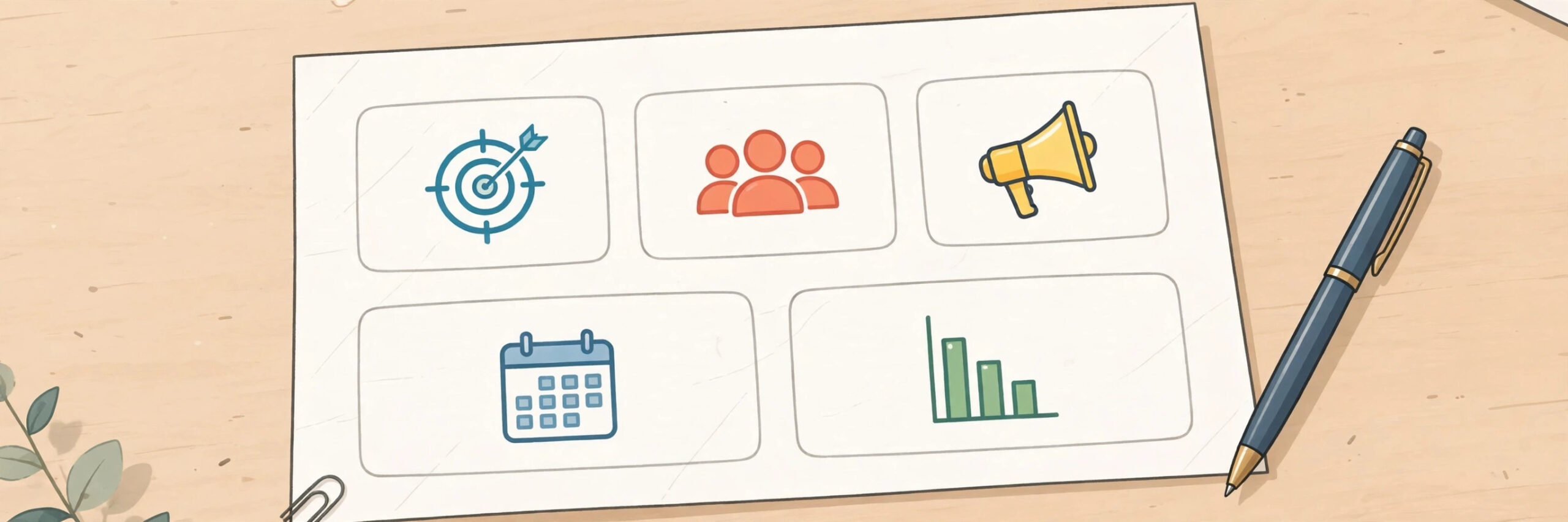
Most small business marketing in Nigeria runs on vibes. A post goes up when there is time, an advert runs when sales feel slow, a promo appears when a competitor does one. Then the owner concludes that online marketing does not work for their business, when the truth is that it was never given a plan to work from. The opposite extreme is no better, a thick strategy document that took weeks to produce and was never opened again. What actually works sits in the middle, a single page that answers five questions clearly enough that you, or anyone helping you, can act on it every week. This guide gives you that page, section by section, with a worked example, and you can complete yours in one afternoon.
Why one page beats a big document
A plan you can see is a plan you will use. One page fits on your wall, in a photo on your phone, and in a weekly five minute review. Every activity you consider can be checked against it in seconds, does this serve the goal, the audience, and the budget on the page? If not, it waits. Most marketing waste is not bad adverts, it is scattered effort, and a visible one page plan is the cure for scatter.
Section 1: Your goal, one number, one deadline
Write a single measurable goal. Not “grow the business” or “get more followers,” but the outcome the marketing must produce, for example, 40 new customer enquiries a month, 15 bookings a week, or ₦500,000 in online sales this quarter. One goal forces choices. If your real problem is enquiries, then content and adverts get judged by enquiries, not by likes, and you stop funding activities that look busy and produce nothing.
Let the goal set the scale. Work backwards from it. If a booking is worth about ₦30,000 and roughly one in five enquiries becomes a booking, then 15 bookings a week means about 75 enquiries a week, which tells you honestly whether your channels and budget can plausibly deliver that, or whether the goal needs staging over two quarters. This small arithmetic is the difference between a plan and a wish.
Section 2: Your audience, described like a real person
Write down who exactly you are trying to reach. Where do they live, what do they do, what phone and platforms do they actually use, and what problem are they trying to solve when they buy what you sell? A caterer in Port Harcourt targeting office lunch orders is marketing to a different human than one targeting wedding clients, even though both sell food.
Include the words they use. Note the phrases customers use when they ask for your product, in person and on WhatsApp, because your adverts and posts should be written in those words, not in your industry’s language. One page forces brevity here too, three or four lines about your best customer beats a vague “everybody aged 18 to 45,” which really means nobody in particular.
Section 3: Your offer and your message
State what you are selling and why they should pick you. One or two sentences covering the offer, a clear price or starting price where possible, and the strongest reason to choose you, speed, quality proof, guarantee, location, or a result customers already praise you for. If you cannot say why you over the shop on the next street, your adverts cannot say it either, and fixing that sentence will improve everything downstream of it.
Decide your proof. List the evidence you can show, testimonials, job photos, numbers served, years operating. Your content plan in the next section exists to put this proof in front of your audience repeatedly, because in Nigerian markets trust is usually the deciding factor, ahead of price.
Section 4: Your channels and your weekly content rhythm
Choose two or three channels, maximum. The ones where your audience from Section 2 actually spends time. For most Nigerian small businesses that means some combination of Instagram, TikTok, Facebook, WhatsApp, and Google search or Maps. Trying to be active on six platforms guarantees being weak on all of them. Two channels done consistently will beat six done in bursts, every quarter of the year.
Write the weekly rhythm, not a content calendar. One page cannot hold thirty posts, and does not need to. Write the pattern instead, for example, two educational posts, one proof post showing real work or a testimonial, one offer post, and WhatsApp status updates daily. A rhythm survives busy weeks because it answers “what do I post today” without fresh thinking, and it keeps your mix balanced between teaching, proof, and selling, instead of drifting into all selling, which audiences quietly tune out.
Section 5: Your budget and your numbers
Set one monthly figure and split it plainly. Decide what you can spend every month without pain, then divide it on the page, for example 60 percent to adverts on your best channel, 25 percent to content production such as data, design help, or a freelancer, and 15 percent held for tests and opportunities. In naira terms, many small businesses start sensibly between ₦50,000 and ₦200,000 a month. A smaller amount spent consistently against a plan outperforms a large amount spent in one anxious burst.
Name the three numbers you will check every week. Choose the numbers that connect to your goal, for example enquiries received, cost per enquiry, and sales closed from online sources. Write them down every Friday, in a notebook or a simple spreadsheet, and compare week to week. Marketing you do not measure becomes marketing you cannot improve, and the one page plan only works if this five minute review actually happens.
A worked example, filled in
Goal: 12 new bookings a month for a mobile spa in Lekki, within 90 days. Audience: Working women aged 28 to 45 in Lekki and Ajah who book treatments after work and on weekends, mostly on Instagram and WhatsApp. Offer and message: Home service spa treatments from ₦25,000, we come to you with everything, rated 4.9 by over 80 clients. Channels and rhythm: Instagram, three posts a week (one treatment explainer, one client proof post, one weekend offer), WhatsApp status daily, one boosted post a week aimed at women within 10 km. Budget and numbers: ₦120,000 a month, ₦80,000 adverts, ₦40,000 content help. Checked weekly: enquiries, cost per enquiry, bookings closed. Notice how every line informs the others. That is the whole design.
Keeping the page alive
Review monthly, adjust quarterly. Markets move, a channel gets expensive, a new offer outperforms the old one. Cross out and update the page in pen if you must, the plan is a working tool, not a framed certificate. But change one major thing at a time and give it at least a month of data, because constant restarting is just scatter with paperwork.
Share it with anyone who helps you. A freelancer, a staff member, or an agency working from your one page will produce work that matches your business. Without it, every helper guesses, and their guesses will not match each other. Five minutes of alignment at the start saves weeks of off message content.
The bottom line
You do not need a consultant or a forty page document to market with direction. One page, honestly filled in, goal, audience, offer, channels with a weekly rhythm, and budget with three numbers to watch, is enough to turn random posting into a system. Fill yours in this afternoon, pin it where you work, and let it judge every marketing idea that reaches you. Then give it ninety days of consistency before you judge it back.
Recommended: Grow Your Business Online
- Facebook Ads Domination (for Business Owners) — learn to run profitable Facebook ads and get more customers ($21). Check it out
- Facebook Advertising In 60 Minutes — fast-track course to launch your first ads in an hour ($50). Check it out
- FAF Mastery System — Facebook ads plus sales funnels that turn clicks into customers ($15). Check it out
Disclosure: These are affiliate links. If you buy through them, I may earn a commission at no extra cost to you.


Leave a Reply