
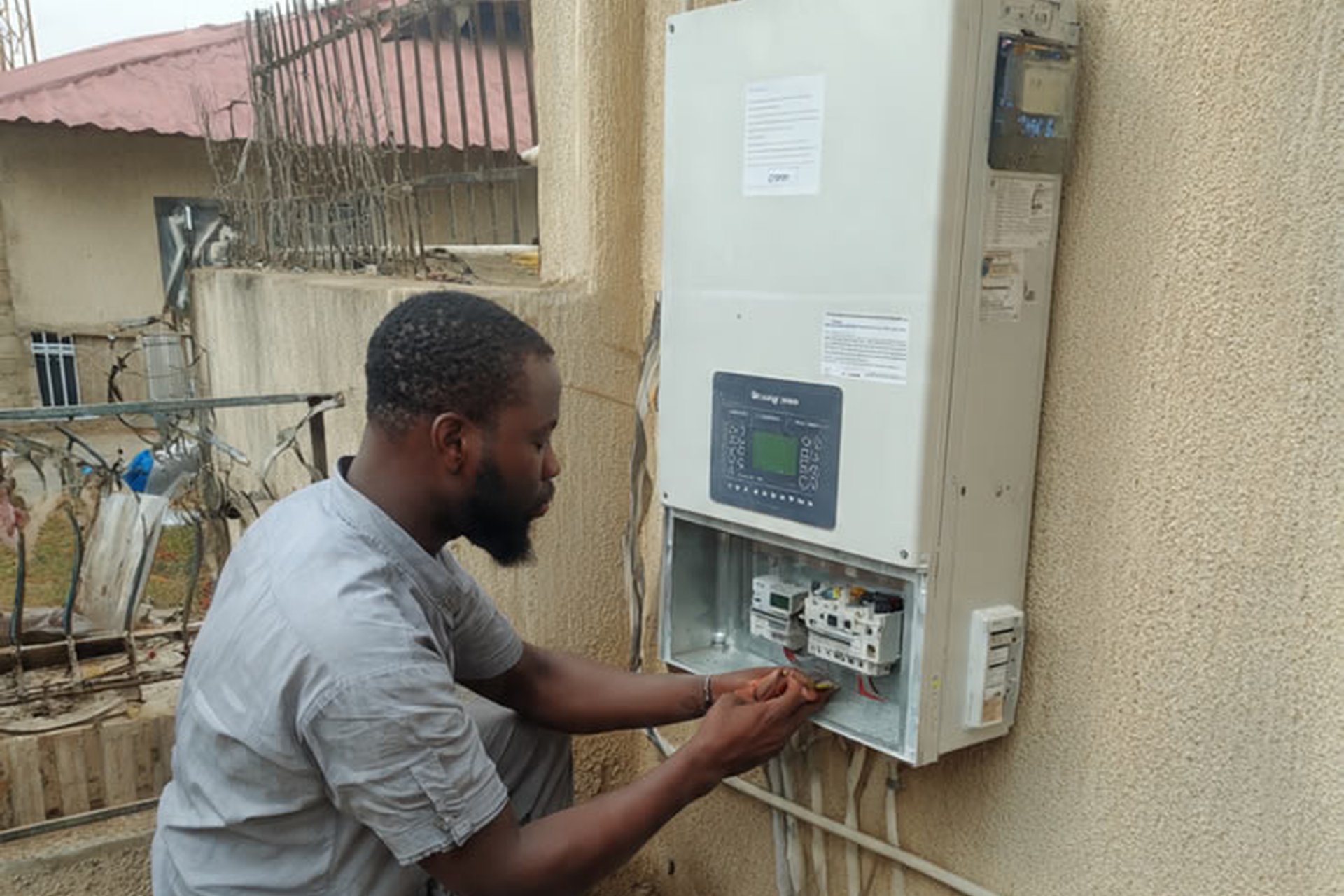
Every Nigerian office knows the sequence. The power cuts without warning, the UPS units start beeping, someone shouts for the generator, and for a few expensive minutes the whole business runs on noise and petrol. The visible cost is fuel. The hidden costs are worse: computers damaged by bad power, files corrupted mid save, batteries in cheap backup units dying every year, and staff sitting idle while a router reboots. Good backup power is not one product. It is three layers that work together: an inverter and battery system for continuity, solar panels to keep those batteries charged cheaply, and surge protection to stop the grid itself from killing your equipment.
Start by counting what truly needs power
List your load in watts, not in guesses. Walk around the office and write down what each device draws: a laptop takes about 65 watts, a desktop with a monitor 150 to 300 watts, a Wi-Fi router about 10 watts, a small printer idles low but spikes hard when printing, and a POS terminal barely sips. Add the numbers up honestly. Most backup power disappointments begin here, with a system sized for the office the owner imagined rather than the one plugged into the wall.
Separate the must run devices from the nice to have ones. Your backup system exists to protect work and revenue: computers, routers, phones on charge, lights in the work area, and the devices that take payments. Air conditioners, fridges, kettles, and water dispensers belong on the grid and the generator, not on your batteries. Every heavy appliance you exclude shrinks the system you need to buy, often by half, and doubles the runtime of what remains.
Match the system to your real outage pattern. Count how many hours of supply your area typically loses on a bad day. A business in an area with six hours of daily supply needs a different battery bank from one facing sixteen hours of darkness. Your recent electricity bills, your generator fuel receipts, and one honest week of observation will tell you more than any salesman’s chart.
Inverters and batteries, sized honestly
The inverter rating is a ceiling, not a promise. A 1.5 kVA inverter comfortably carries roughly 1,000 to 1,200 watts of load, and running any inverter flat out at its limit shortens its life. Buy headroom: if your must run load is 800 watts, a 1.5 kVA unit in the range of ₦180,000 to ₦300,000 works gently and survives. Undersized inverters fail at the exact moment everyone plugs in at once, which is the moment you bought them for.
Batteries decide your runtime, and chemistry decides your lifespan. A 200 Ah tubular battery, costing roughly ₦280,000 to ₦380,000, is the workhorse of Nigerian offices and lasts two to four years if it is not drained flat daily. Lithium batteries cost far more upfront, commonly ₦900,000 and above for a comparable usable capacity, but they charge faster, tolerate deep discharge, and last two to three times longer. Over five years, the lithium option often wins on total cost. Over one tight year, tubular wins on cash flow. Choose with your eyes open.
Do the runtime maths before you pay, not after. A 200 Ah battery at 12 volts stores about 2.4 kilowatt hours, and a lead acid battery should only give up about half of that regularly, so plan on roughly 1.2 usable kilowatt hours. A 300 watt load of laptops, lights, and a router therefore runs for about four hours. If your bad day is eight hours, you need two batteries or a smaller load. Any seller who will not do this arithmetic with you in the shop is selling you a surprise.
Solar panels that earn their keep
Panels charge batteries; they do not replace them. Solar’s job in an office system is to refill the battery bank during the day. Panels sized well mean the inverter batteries end most days full, the generator stays off, and the system is ready for the evening cut. A typical small office setup of two to four 550 watt panels costs roughly ₦400,000 to ₦900,000 installed, depending on mounting and cabling.
Size panels against your daytime load and your roof. Panels produce their rated power only in strong, direct sun, and Nigerian harmattan haze and rainy season clouds will tax them. A practical rule is to install panel capacity at least equal to your daytime load, so the office runs on sunshine while the batteries charge from the surplus. Confirm your roof or compound space, its direction, and its shade before paying, because a beautiful panel under a neighbour’s tree is an expensive decoration.
The payback arrives as fuel not bought and batteries not buried. Every hour of solar charging is an hour the generator rests, and petrol and diesel savings accumulate quietly month after month. Just as important, batteries that are charged gently by day and rarely drained flat last noticeably longer, and battery replacement is the largest recurring cost of any backup system. Solar looks like the optional layer. In a three year budget, it is often the layer that makes the other two affordable.
Surge protection, the cheap layer everyone skips
The returning grid is more dangerous than the departing one. When supply is restored, voltage can spike far above normal before it settles, and repeated small surges from switching and faulty connections degrade electronics slowly. Computers, routers, and printers rarely die during an outage. They die in the first second of the restoration, or they weaken surge by surge until a random Tuesday finishes them. One spike can write off a ₦600,000 laptop and the work stored on it.
Protect at two points, not one. Fit a proper surge protection device at your distribution board, installed by an electrician, to guard the whole office, then use quality surge protected strips at each desk for the sensitive equipment. Together they cost in the range of ₦15,000 to ₦60,000 for a small office, which is less than the repair bill for a single damaged motherboard. Cheap extension boxes with a red switch are not surge protection. Look for a stated joule rating and a clamping voltage.
Replace protectors after they have done their job. Surge devices are sacrificial: each spike they absorb consumes part of their life, and many fail silently, still passing power while protecting nothing. Note the installation date, check indicator lights monthly where fitted, and budget to replace desk strips every two to three years, or sooner after a major electrical event. A protector that has saved your computers once has already repaid its price several times over.
The bottom line
Reliable office power is a system, not a purchase. Count your real load and protect only what must run, size the inverter with headroom and the batteries with honest maths, let solar carry the daytime charging so fuel and battery costs fall, and wrap everything in surge protection at the board and at the desk. Bought in that order, each layer makes the next one cheaper, and the next outage becomes a beep and a shrug instead of a crisis.
Recommended: Grow Your Business Online
- Facebook Ads Domination (for Business Owners) — learn to run profitable Facebook ads and get more customers ($21). Check it out
- Facebook Advertising In 60 Minutes — fast-track course to launch your first ads in an hour ($50). Check it out
- FAF Mastery System — Facebook ads plus sales funnels that turn clicks into customers ($15). Check it out
Disclosure: These are affiliate links. If you buy through them, I may earn a commission at no extra cost to you.


Leave a Reply