
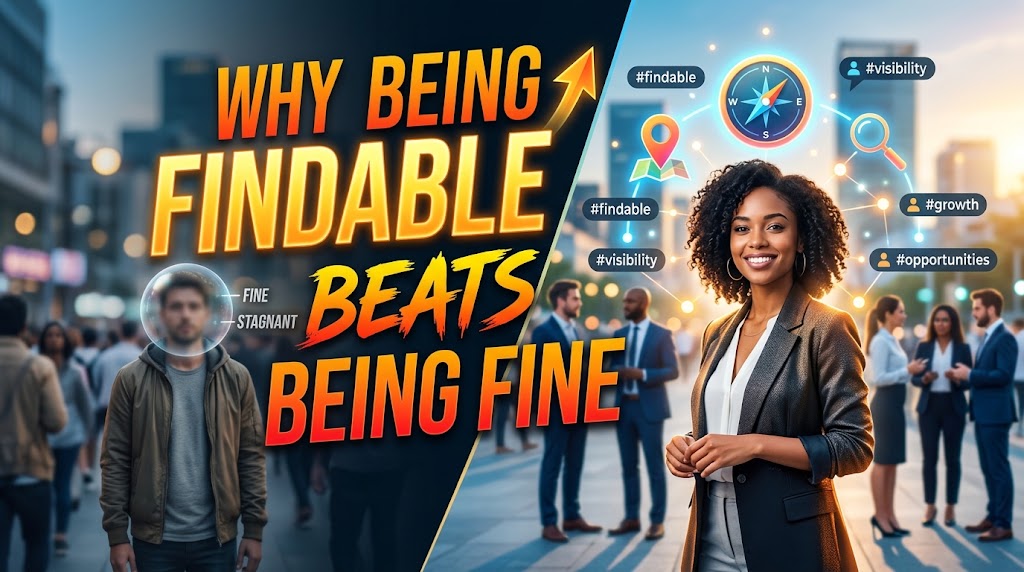
There is a strange problem many businesses have today. They look good, they offer good products, their services are excellent, their social media pages may even be attractive, but when a potential customer needs what they sell, nobody can find them. This is one of the biggest reasons I believe that Why Being Findable Beats Being Fine is more than just a catchy statement. It is a serious lesson for anyone trying to build a business in the digital age.
Being good at what you do is important. Looking professional is important. Having quality products is important. But if people cannot find you when they are searching for the exact thing you offer, your quality may remain your best kept secret.
Imagine that you own a restaurant with excellent food. Your meals are delicious, your environment is beautiful and your customer service is fantastic. You have spent money decorating the place and you have even taken professional pictures of your dishes. Unfortunately, the restaurant is located somewhere customers rarely pass, there is no signboard and nobody can find your business when they search online.
You could have the best jollof rice in the city, but if nobody knows where you are, your jollof rice may become a family secret.
That is the problem with being fine without being findable.
A business does not only need to be good. It needs to be discoverable.
This is where the idea behind Why Being Findable Beats Being Fine becomes extremely important. In today’s marketplace, customers are constantly searching. They search Google. They search social media. They search maps. They ask questions online. They look for reviews. They compare businesses before spending money.
The question is no longer simply, “Are you good?”
The question is also, “Can people find you?”
You may have the best service in your area, but if another business with an average service has a better online presence, that business may receive the customer before you even get the opportunity to compete.
This does not mean quality is irrelevant. Far from it. Quality keeps customers. Findability brings them to the door.
Think about it this way. Being good is your product. Being findable is your distribution.
You can have an amazing product sitting in a warehouse, but if nobody knows it exists, it will not generate meaningful sales. The same thing happens with businesses online.
I have come to realise that many business owners spend enormous amounts of time trying to make their businesses look perfect while spending very little time making those businesses easy to find.
They redesign their logos.
They change their colours.
They create beautiful flyers.
They take professional photographs.
They write impressive descriptions.
They create social media posts.
All of these things have value. But there is one uncomfortable question that should come before all of them: if someone searches for the product or service I provide today, will they find me?
That question can expose a lot of weaknesses very quickly.
You might have a beautiful business name, but perhaps your business does not have a website. You might have a social media account, but perhaps your important information is buried under hundreds of posts. You might have loyal customers, but perhaps someone who has never heard of you has no easy way to verify that you are legitimate.
This is why Why Being Findable Beats Being Fine is such an important concept for modern entrepreneurs.
Findability creates opportunity.
When someone searches for a service and your business appears, you have entered the conversation. You may not win the customer immediately, but at least you have been given a chance.
If you do not appear at all, you are not competing.
You are absent.
And absence can be expensive.
Consider a simple example. Someone needs a website developer. They do not necessarily know you personally. They may search for website developers in their city, browse websites, look at portfolios, check reviews and compare prices.
If your business has no website, no useful online information and no strong digital footprint, the customer may never know you exist.
Meanwhile, another developer who may not necessarily be better than you has a professional website explaining their services, showing previous projects, answering common questions and making it easy to contact them.
Who do you think appears more trustworthy?
This is one of the reasons a website can be more than just an online brochure. It can become a digital location for your business.
Your physical office may close at 6pm. Your website does not need to sleep.
Your salesperson cannot speak to everyone simultaneously. Your website can communicate with multiple visitors at the same time.
Your business card may be misplaced. Your website can remain searchable.
Your social media post may disappear down someone’s timeline. Your website pages can continue attracting people through search engines long after you publish them.
This is why being findable can produce a completely different business experience.
There is also a major difference between being visible and being findable.
You can be visible to your followers without being findable to strangers.
For example, you might post on Facebook every day and receive likes and comments from people who already know you. That is visibility.
But imagine someone who has never heard your name searching for exactly what you offer. If your business appears in their search results, that is findability.
The second situation can be incredibly powerful because it connects you with people who already have a need.
That distinction is important.
Traditional advertising often involves interrupting people. You place an advert in front of someone and hope they become interested.
Search-based discovery is different. Someone already has a problem. They are looking for a solution. If your business appears at the right moment, you are no longer interrupting them. You are answering them.
That is why businesses should take search seriously.
People are asking questions every day.
“How much does this cost?”
“Where can I buy this?”
“Who provides this service?”
“Which hotel is near this location?”
“How do I register a business?”
“Who builds websites?”
“Where can I find a reliable plumber?”
“Which company offers this service?”
Every question represents a potential business opportunity.
The challenge is that your competitors are also trying to answer those questions.
Being findable therefore becomes a competitive advantage.
It is not enough to say, “My customers know me.”
Your existing customers may know you. But what about the next 100 customers?
What about the person who needs your service today but has never heard your name?
What about someone who moves into your neighbourhood next month?
What about someone who receives a recommendation but wants to verify your business before contacting you?
What about the person who sees your name somewhere and searches for you?
The internet has changed the way trust works.
People often investigate businesses before buying from them. They may search the business name, visit its website, look at its social media accounts, read reviews and examine the information available online.
This means your digital presence can influence how people perceive your credibility before you ever speak to them.
A strong online presence does not automatically make a business trustworthy. But a weak or confusing presence can certainly make a potential customer hesitate.
This is another reason Why Being Findable Beats Being Fine matters.
Being fine means your business exists.
Being findable means your business can be discovered.
And discovery is the beginning of many transactions.
One of the biggest mistakes business owners make is assuming that having a social media account means they already have a complete online presence.
Social media is valuable, but it should not necessarily be your entire digital foundation.
Platforms change.
Algorithms change.
Reach changes.
Rules change.
Accounts can become difficult to access.
Posts can become buried.
A website gives your business a space that is specifically designed around your brand, your information, your services and your customers.
Why Being Findable Beats Being Fine
Your website can explain who you are, what you offer, where you operate, how people can contact you, what customers say about you and why someone should choose you.
More importantly, properly structured website content can help search engines understand what your business does.
This is where search engine optimisation becomes important.
SEO is not simply about stuffing keywords into an article. It is about helping search engines understand your content and helping users find useful answers.
When you create valuable pages around the questions your customers are already asking, you increase the possibility of being discovered by people who need what you offer.
This is why businesses should stop thinking about websites only as digital decorations.
A website should be treated as an asset.
It can educate.
It can attract.
It can build credibility.
It can generate enquiries.
It can collect leads.
It can showcase products.
It can answer questions.
It can provide directions.
It can make it easier for people to contact you.
It can help you appear in searches.
It can work while you are sleeping.
That last part deserves attention.
You may be sleeping at 2am, but somebody somewhere could be searching for the service you provide.
Your office may be closed.
Your phone may be silent.
You may not even know that the person exists.
But if your website appears in their search results and gives them enough information to take the next step, your digital presence has done some work for you.
This does not mean a website magically creates money.
A website with poor content, poor user experience and no strategy can sit online unnoticed.
The goal is not simply to own a website.
The goal is to build a website that deserves to be found.
That means understanding your customers.
What are they searching for?
What problems are they experiencing?
What questions do they ask before buying?
What locations do they search?
What information do they need before trusting you?
What objections stop them from purchasing?
Your website should answer these questions.
For example, a hotel should not only publish its name and phone number. It can create useful information around its location, rooms, facilities, booking process and frequently asked questions.
A real estate company should not only display properties. It can educate potential buyers about documentation, land verification, property inspections, buying processes and common mistakes.
A website developer should not only say, “I build websites.” The developer can explain website costs, domain names, hosting, maintenance, SEO, security, website types and the benefits of owning a business website.
This kind of content creates multiple entry points.
Someone may not know your business today, but they may discover an article tomorrow.
That article may lead them to another page.
Another page may introduce them to your service.
Eventually, the person who arrived looking for information may become a customer.
That is the power of being findable.
It also changes the way you think about content creation.
Many business owners ask, “What should I post today?”
A better question is, “What problem can I solve today that my potential customers are already searching for?”
That small change in thinking can transform your content strategy.
Instead of creating content simply to remain active, you create content that has a purpose.
Instead of chasing likes, you begin building discoverability.
Instead of constantly announcing that you sell something, you start demonstrating that you understand the problems your customers face.
This is where many businesses can gain an advantage.
Your competitor may have more followers than you.
Your competitor may have a bigger advertising budget.
Your competitor may have a more attractive office.
But if you consistently create useful information and make your business easy to discover, you can still build your own audience.
The internet has created opportunities for smaller businesses to compete with larger ones through expertise, consistency and strategic visibility.
However, being findable is not only about Google.
It includes your entire digital footprint.
Someone may discover you through Facebook.
Someone else may find you through Instagram.
Another person may see your business on Google Maps.
Someone may discover your website through a search engine.
Another person may hear your name from a friend and search for your business.
The important thing is that wherever people look, they should be able to find enough accurate information to understand who you are.
Consistency matters here.
Your business name should not be completely different across platforms.
Your contact information should be accurate.
Your services should be clearly explained.
Your location should be properly represented where relevant.
Your website should work properly.
Your pages should load reasonably well.
Your content should answer real questions.
Your business should look alive.
These details may appear small, but collectively they influence the experience someone has when researching your business.
There is another uncomfortable truth.
Sometimes the business that gets the customer is not the best business.
It is simply the business the customer found first and trusted enough to contact.
That may sound unfair, but business has never promised to be fair.
Customers cannot buy from businesses they cannot identify.
They cannot enquire from businesses they cannot locate.
They cannot recommend businesses they cannot remember.
They cannot trust information they cannot verify.
This is why you should take your digital discoverability seriously.
Do not spend all your energy making your business “fine” while ignoring whether people can find it.
Build the quality.
Build the brand.
Build the service.
But also build the pathway that leads people to you.
If you are a business owner, take a few minutes and search for your own business as if you were a stranger.
Do not search only your business name.
Search for the service you provide.
Search for your service plus your location.
Search for the problem your product solves.
Search for common questions customers ask before buying from you.
Then observe what appears.
Do you appear?
Is your information accurate?
Can someone understand what you do?
Can they contact you?
Does your website appear?
Does your business profile appear?
Are there reviews?
Are your competitors dominating the results?
This simple exercise can reveal opportunities you may have been ignoring.
The goal is not to become famous.
The goal is to become discoverable by the right people.
There is a difference.
You do not need everyone on the internet to know your name. You need the people who need what you offer to have a realistic opportunity to find you.
That is why Why Being Findable Beats Being Fine should become a serious business principle.
Fine is subjective.
Findable is measurable.
You can measure website traffic.
You can monitor search visibility.
You can track enquiries.
You can analyse which pages people visit.
You can see which content attracts attention.
You can identify where potential customers are coming from.
You can improve what is not working.
Being findable gives your business more chances to participate in the marketplace.
And every additional legitimate opportunity to be discovered can become valuable.
Of course, findability should never replace excellence.
If you are easy to find but provide terrible service, your visibility will eventually expose your weaknesses.
The ideal combination is simple.
Be good.
Be useful.
Be trustworthy.
And be findable.
Quality gives people a reason to stay.
Findability gives them a chance to arrive.
That is the real lesson behind Why Being Findable Beats Being Fine.
Your business does not need to shout louder than everyone else. Sometimes it simply needs to be present when the right person starts looking.
The business owner who understands this stops treating the internet as a place to merely post pictures and begins treating it as a marketplace.
They stop asking only, “How can I make my business look better?”
They start asking, “How can I make my business easier to discover?”
That question can lead to a better website, better content, better SEO, better business listings, better customer education and ultimately better opportunities.
Because in business, being excellent matters.
But excellence that nobody can discover has limited commercial power.
You could be the best tailor in your city.
You could prepare the best food in your neighbourhood.
You could sell excellent products.
You could provide outstanding professional services.
You could solve a problem better than most people in your industry.
But if your potential customers cannot find you, your competitors may receive the phone calls, messages and enquiries that could have been yours.
So, build something worth finding.
Then make sure people can actually find it.
That is why being findable beats being fine.
Recommended: Grow Your Business Online
- Facebook Ads Domination (for Business Owners) — learn to run profitable Facebook ads and get more customers ($21). Check it out
- Facebook Advertising In 60 Minutes — fast-track course to launch your first ads in an hour ($50). Check it out
- FAF Mastery System — Facebook ads plus sales funnels that turn clicks into customers ($15). Check it out
Disclosure: These are affiliate links. If you buy through them, I may earn a commission at no extra cost to you.


Leave a Reply