
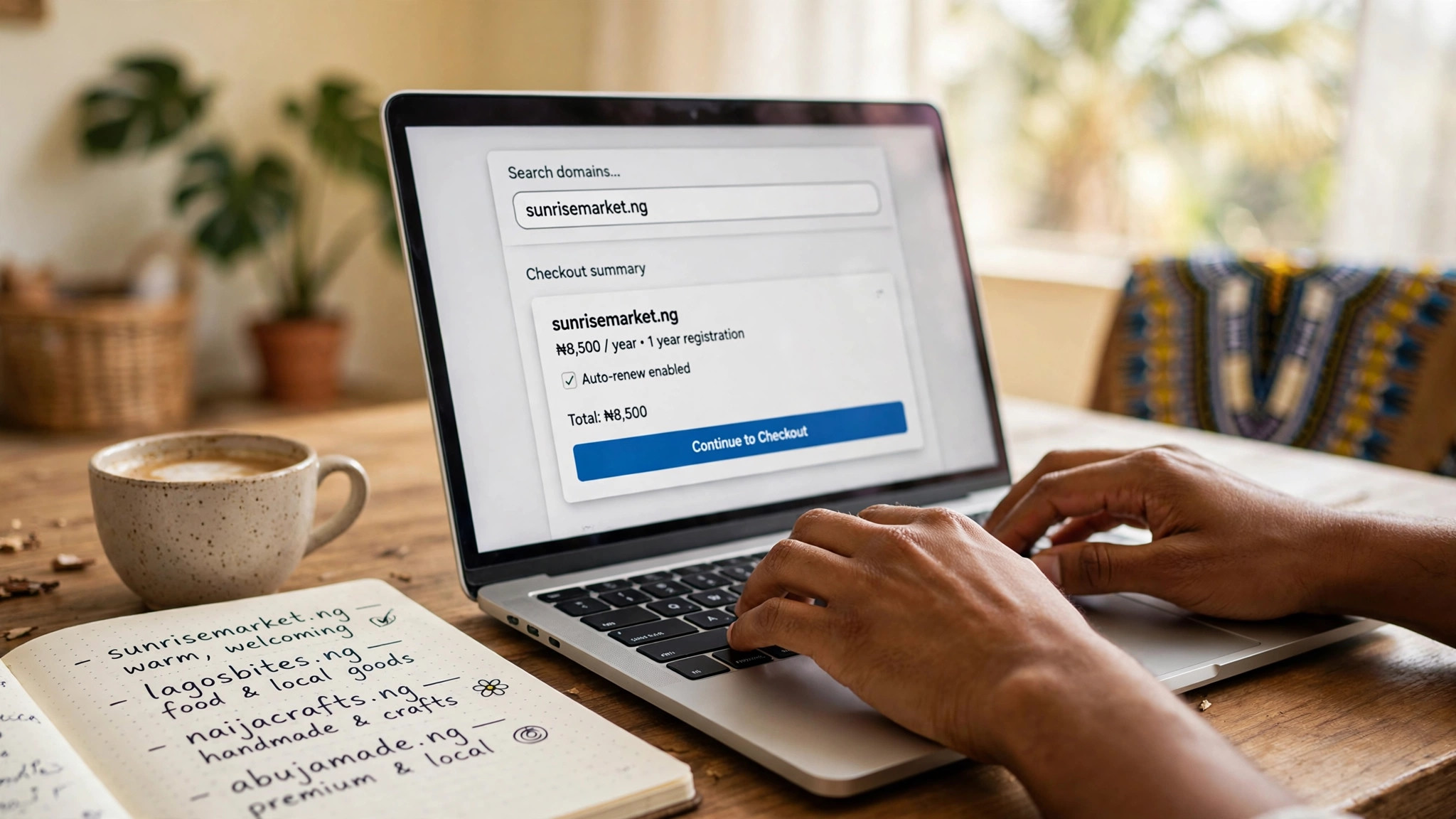
Before you build a website, you need an address for it. That address is the domain name, the part people type into their browser, like franklyntechnologies.com.ng or jumia.com.ng. This guide explains what a domain actually is, how.com and.ng differ, what they typically cost in naira, and how to choose a name you will not regret.
What a domain name really is
Every website lives on a computer called a server, and every server has a numeric address, something like 192.0.2.44. Nobody remembers those, so the domain system translates human-friendly names into those numbers behind the scenes. When someone types your domain into a browser, their phone or computer looks up the matching server address and loads your site.
You do not buy a domain outright; you rent it, usually one year at a time, from a company called a registrar. As long as you keep renewing, it is yours. Let it expire, and anyone else can grab it, including competitors and the speculators who buy expired domains hoping to sell them back at inflated prices.
.com vs.ng vs.com.ng
A.com domain is the global default. It works everywhere, customers everywhere recognise and trust it, and it is the easiest to remember. If your business serves customers beyond Nigeria, or you simply want the most familiar option,.com is the safe pick. Registration typically costs a few thousand naira per year, though premium prices at renewal time are a known trap, which we will cover below.
.ng is Nigeria’s country domain, managed locally. It signals a Nigerian business immediately, which can build trust with local customers, and short, catchy names are often still available in.ng when the.com version is long gone. It typically costs more than.com, roughly in the low tens of thousands of naira per year, and it shows commitment to the Nigerian market.
.com.ng sits in the middle: Nigerian identity with a familiar shape, and usually cheaper than a straight.ng, often just a few thousand naira per year. Many Nigerian businesses use.com.ng as their main address and it works perfectly well for local SEO and customer trust.
You can also own more than one. A common move is to register your.com as the main site and grab the.ng or.com.ng version too, pointing them all at the same website. That stops impersonators and catches customers who type the wrong ending.
How to pick a good name
Keep it short. Every extra word is another chance for a customer to mistype it or forget it. Aim for two or three words at most. “LagosCakes.com” beats “BestAffordableCakesInLagosNigeria.com” in every way that matters.
Make it memorable and easy to say. Test it with the phone test: if you tell someone your domain over a crackly phone call, can they spell it correctly? If not, simplify. Avoid clever spellings that only make sense in writing.
Avoid hyphens and numbers. Hyphens get forgotten, and numbers create confusion (“is that the digit 4 or the word four?”). A clean, hyphen-free name is worth paying a little more for, or choosing a different name entirely.
Match your business name when you can. If your registered business is Adaeze Hair Ventures, something like adaezehair.com.ng is instantly credible. If the exact name is taken, add a short word like “get”, “shop”, or “ng” rather than mangling the name with hyphens.
Check social handles too. Before you commit, search Instagram, Facebook, TikTok, and X for the same name. A domain that matches your social handles makes your whole brand easier to find and harder to impersonate.
Think long term. Pick a name that still fits if you expand. “IkejaPhoneRepairs.com” becomes a problem the day you open in Lekki. A slightly broader name gives you room to grow.
Where to buy, in general terms
Buy from an established domain registrar, a company whose whole business is selling domains, rather than from a random “web guy” who registers it under his own account. Big international registrars and reputable Nigerian registrars both work; what matters is that the domain is registered in your name, under an email address you control, with the login credentials in your hands. If a developer offers to “handle the domain for you,” say yes to the help but insist the account and ownership are yours. Domains registered under someone else’s account have caused countless Nigerian business owners to lose their websites in disputes.
Renewal gotchas that catch people
The first-year discount trap. Many registrars advertise a cheap first year, then charge the normal, higher price on renewal. Always check the renewal price before you buy, not just the headline price. A domain advertised at a steep discount can renew at several times that amount.
Auto-renewal. Turn it on. An expired domain takes your website and your business email offline, and recovering it can cost far more than the renewal. The renewal fee is small; the cost of downtime is not.
Keep your contact email current. Renewal reminders go to the email on the account. If that is an old Yahoo address you no longer open, you will miss the warnings. Use an email you actually check.
Beware of transfer locks and surprise fees. A legitimate registrar never charges you a large fee to keep a domain you already paid for. If you get alarming emails about your domain expiring from a company you never used, it is likely a scam; check your real registrar account directly instead of clicking the email link.
The bottom line
A domain name is cheap, but it is the foundation your whole online presence stands on, so choose deliberately: short, memorable, no hyphens, registered in your own name, with auto-renewal switched on. Spend an afternoon getting this right and you will never think about it again. Get it wrong, and you may be explaining a confusing web address to every customer for years.
Recommended: Grow Your Business Online
- Facebook Ads Domination (for Business Owners) — learn to run profitable Facebook ads and get more customers ($21). Check it out
- Facebook Advertising In 60 Minutes — fast-track course to launch your first ads in an hour ($50). Check it out
- FAF Mastery System — Facebook ads plus sales funnels that turn clicks into customers ($15). Check it out
Disclosure: These are affiliate links. If you buy through them, I may earn a commission at no extra cost to you.


Leave a Reply