
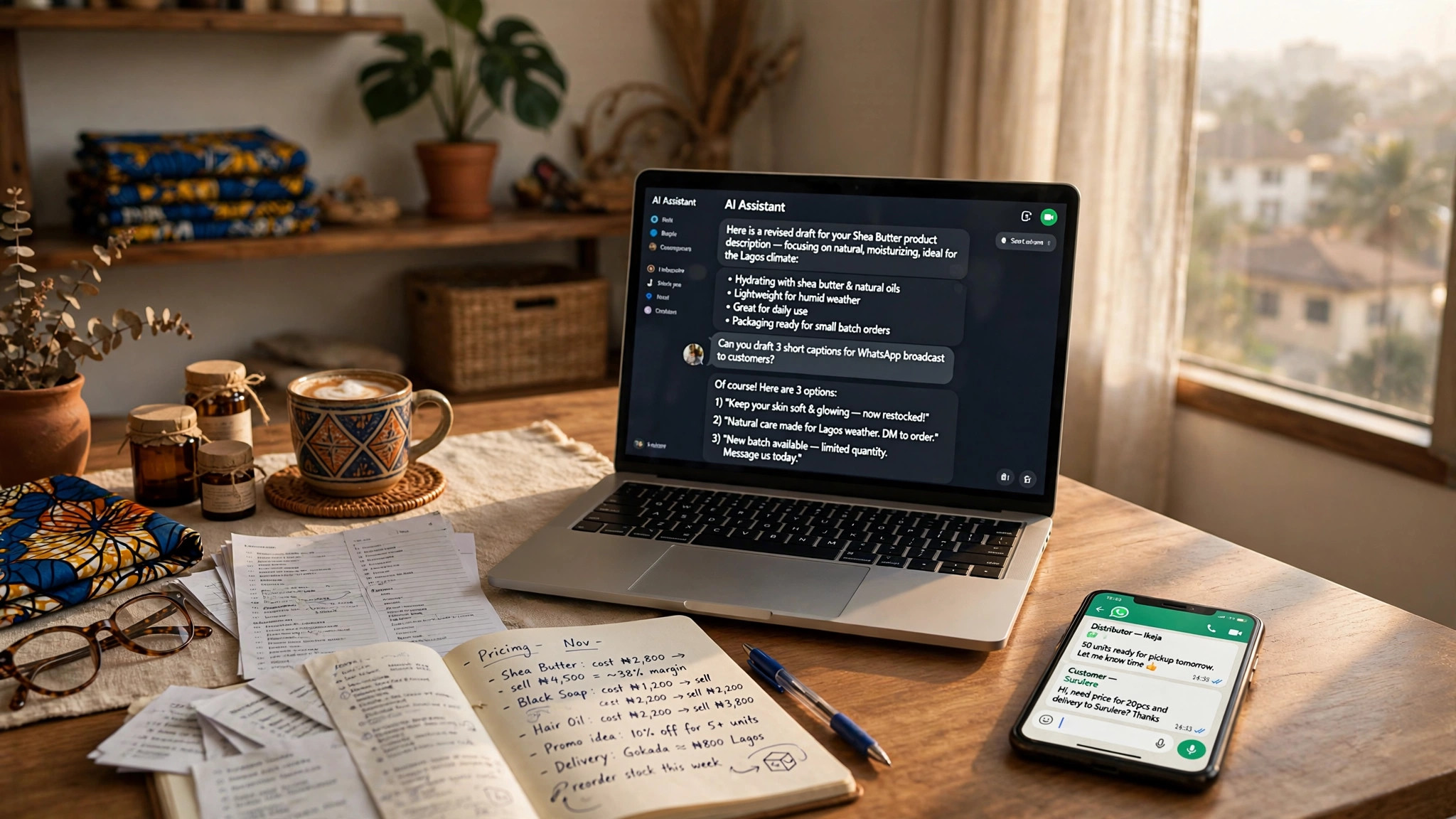
ChatGPT is most useful to a business owner not as a clever chatbot, but as a tireless assistant that drafts, plans, and writes in seconds. The catch: it only helps if you ask well. Vague requests get vague answers. Below are ten copy-paste prompts, written for Nigerian business realities, WhatsApp broadcasts, price haggling, NEPA-era delivery apologies, staff rosters, that you can use daily. Paste each one in, fill in the bracketed parts, and edit the result in your own voice before sending.
1. The WhatsApp broadcast writer. What it does: turns your rough promo idea into a broadcast message customers actually read.
“Write a WhatsApp broadcast message for my [type of business, e.g. thrift clothing store] in [city]. I am running [offer, e.g. 20% off all corporate wear this weekend only]. Keep it under 60 words, friendly Nigerian tone, start with a hook, end with a clear call to action telling customers to reply to this chat to order. Add 2 emojis maximum.”
2. The polite price-haggling reply. What it does: helps you hold your price without sounding rude when customers push for discounts.
“A customer is haggling hard on my [product], priced at [₦ amount]. They want it for [₦ lower amount], which is below my cost. Write a polite, firm WhatsApp reply in Nigerian English that explains the quality justifies the price, offers [small concession, e.g. free delivery within Lagos] instead of a price cut, and keeps the door open for the sale.”
3. The product description generator. What it does: converts a plain item into a selling description for Jumia, Instagram, or your website.
“Write a compelling product description for [product name and key details, e.g. handmade leather slippers, brown, sizes 40-45]. Target buyer: [e.g. working-class men in Lagos aged 25-45]. Include: a benefit-led opening line, 4 bullet points of features, and a closing line urging immediate purchase. Tone: confident and relatable. Keep it under 120 words.”
4. The weekly staff roster planner. What it does: builds a fair shift schedule from your staff list and constraints.
“Create a weekly staff roster for my [business type] with [number] staff: [names and any constraints, e.g. Ada cannot work Sundays, Emeka prefers mornings]. We are open [hours, e.g. 8am to 9pm daily]. Each person works [e.g. 6 days with 1 day off], and morning and evening shifts must both be covered. Present it as a clear day-by-day table.”
5. The difficult customer reply. What it does: drafts a calm, professional response to complaints or bad reviews.
“A customer left this complaint: ‘[paste their message]’. Write a calm, professional reply that apologises without admitting fault beyond what is fair, explains what we will do to fix it [describe your fix], and invites them back. Tone: warm and respectful, Nigerian business English. Keep it under 100 words.”
6. The Instagram caption pack. What it does: gives you a week’s worth of captions so you never stare at a blank screen.
“Write 7 Instagram captions for my [business type] in [city]. Mix: 2 promotional, 2 educational or tips, 2 behind-the-scenes or personal, 1 engagement question. Each under 40 words, conversational Nigerian tone, each ending with a call to action. Add 5 relevant hashtags at the end of each.”
7. The overdue payment follow-up. What it does: writes firm but relationship-safe reminders for customers owing you money.
“Write 3 escalating payment reminder messages for a customer who owes me [₦ amount] for [product/service], now [number] days overdue. Message 1: friendly nudge. Message 2: firm but polite, sent a week later. Message 3: final notice mentioning next steps. Each under 50 words, suitable for WhatsApp, professional Nigerian tone.”
8. The supplier price comparison. What it does: organises supplier quotes into a decision-ready comparison.
“I have quotes from 3 suppliers for [item]: Supplier A: [price and terms]; Supplier B: [price and terms]; Supplier C: [price and terms]. Compare them on price, payment terms, delivery time, and reliability risk. Recommend the best overall value, not just the cheapest, and list 3 questions I should ask the winner before paying.”
9. The business idea validator. What it does: pressure-tests a new product or service idea before you spend money on it.
“I want to start [business idea, e.g. selling packaged ofada rice online to Lagosians]. Ask me 10 tough questions about costs, customers, competition, and delivery logistics, one at a time, waiting for my answer each time. After I answer all 10, give me an honest verdict: proceed, adjust, or drop it, with reasons.”
10. The end-of-day review. What it does: turns your rough daily notes into a clear summary and tomorrow’s priorities.
“Here are my rough notes from today: [paste your notes, e.g. sales, issues, ideas]. Summarise them into: 1) What went well, 2) Problems to fix, 3) Top 3 priorities for tomorrow. Keep it brief and actionable, like a personal business coach.”
Getting better answers: three rules
Be specific about context. “Write a message for my business” gets generic output. “Write a WhatsApp broadcast for my thrift store in Surulere, weekend sale, under 60 words” gets something usable. The bracketed details are doing the real work in every prompt above.
Always edit before sending. AI drafts are starting points, not finished work. Check prices, names, and promises before anything goes to a customer, and adjust the tone to sound like you. Your customers buy from a person, not a chatbot.
Save your winners. When a prompt produces a great result, save the exact wording in your notes app. Within a month you will have a personal library of twenty or thirty proven prompts, and the daily tasks that used to eat your evenings, replies, rosters, captions, will take minutes.
The bottom line
You do not need to learn “AI” as a subject. You need ten good prompts for the ten repetitive writing tasks that already fill your day. Start with the two or three you will use this week, refine them as you go, and let the assistant handle the drafting while you handle the business.
Recommended: Grow Your Business Online
- Facebook Ads Domination (for Business Owners) — learn to run profitable Facebook ads and get more customers ($21). Check it out
- Facebook Advertising In 60 Minutes — fast-track course to launch your first ads in an hour ($50). Check it out
- FAF Mastery System — Facebook ads plus sales funnels that turn clicks into customers ($15). Check it out
Disclosure: These are affiliate links. If you buy through them, I may earn a commission at no extra cost to you.


Leave a Reply